
Vibe Coding Turns One: The Year That Changed How We Build Software
From Karpathy's viral tweet to Collins' Word of the Year. What existed before vibe coding, what changed in 12 months, and where we go from here.
A year ago, "vibe coding" didn't exist. Today, it has become the 'go-to' tool for developers, and even for startup founders with little or no coding experience. How did that happen in the space of less than one year?
It all started (as things sometimes do) with a tweet:
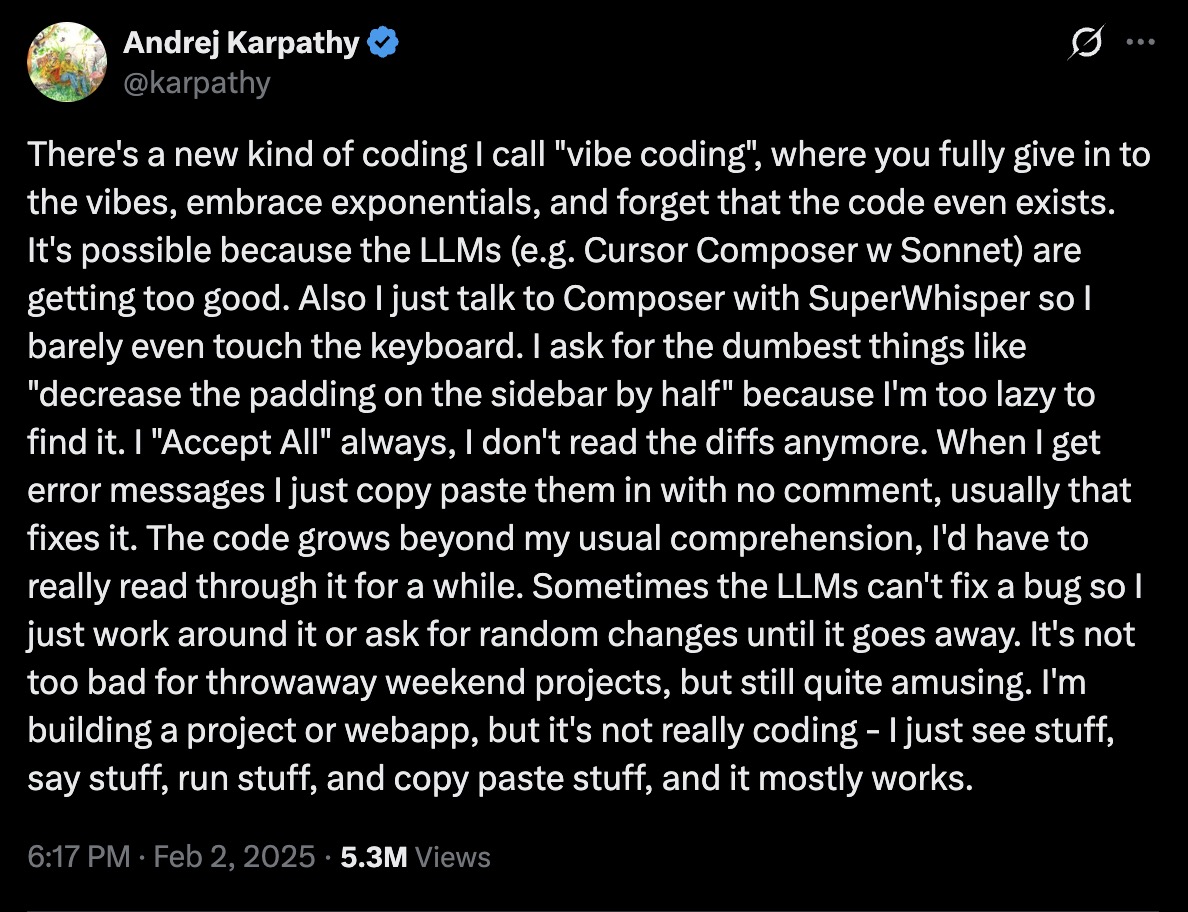
Andrej Karpathy is an influential AI expert, who has worked at Tesla and OpenAI. His tweet put a name to what many developers had begun doing - writing code by using plain English prompts with LLMs.
By the end of the year, the Stack Overflow developer survey found that 84% of developers vibe code (or plan to start vibe coding), and 47% vibe code every day. The study also found that 41% of all code is AI-generated.
The capping achievement — signifying that vibe coding has hit the mainstream — Collins Dictionary made vibe coding its word of the year for 2025.
#What Is Vibe Coding? A Definition for the Anniversary
Vibe coding is a huge shift in the way code is written. Rather than typing each line of code, developers describe what they want in natural language, and let AI agents generate the code. It is generally used to complete larger projects, features or modules of code.
Karpathy's definition in his tweet describes a very cavalier approach to vibe coding ("Fully give in to the vibes...and forget that the code even exists."). He expands the vibe to include that he just runs with whatever the LLM spits out - blindly accepting every line of code, not reading the differences, and offering the LLM random changes to fix bugs in his code.
Most vibe coding developers use more nuance. The Stack Overflow survey found that 19.6% of developers highly distrust the output of AI tools, and only 33% have trust in the output. When vibe coding on a commercial product, vibe coders find that they must be more careful - reviewing and analyzing the code before accepting it.
#Vibe coding vs. autocomplete
GitHub Copilot is an autocomplete AI that ingests the code being typed and creates autocompleted segments of code. Vibe coding is (generally) used for larger scale code changes like adding features, or refactoring sections of code.
#What Existed Before Karpathy Named It?
Vibe coding existed before the name was coined. Copilot launched in 2021, ChatGPT in 2022, and Cursor Composer in 2024 - all lowering the barrier for developers to use AI agents as a part of their coding tooling. In 2023, Karpathy himself tweeted "The hottest new programming language is English."
AI began with the autocomplete tools, and as LLMs become more powerful, developers began leveraging them to write and analyze code from English prompts. At the dawn of 2025, Agentic AIs were entering the marketplace giving rise to agents capable of multi-step execution, full repository awareness and partial autonomy - the ability to "just build it."
By the time Karpathy tweeted about vibe coding in February 2025, millions of people were already using AI to code, and the wave of agentic tools to reason and write code was taking off. They just didn't have a name for it yet.
#Further back: the evolution of coding
Vibe coding is the next abstraction of coding. Assembly hid machine code. C hid assembly. Python hid memory management. Vibe coding further abstracts coding away from the programming language to the written word. Each abstraction step in programming has been met with resistance from traditionalists. But each abstraction step eventually won, and became the preferred way for code to be created.
#2025: The Year Everything Accelerated
The massive adoption of vibe coding didn't happen because it was given a name. The explosion in vibe coding tooling — and the interest in these tools from the developer community — drove the massive acceleration.
Cursor, Claude Code, Windsurf are among the new tools that allowed Agentic AI vibe coding to take off in 2025.
All of a sudden AI wasn't just commenting or making small changes. AI was taking the entire code context and creating new features based on existing code. Agents now plan, implement, review, test, and fix code — all from a single prompt.
2025 also saw the rise of Model Context Protocol which gives the agents even deeper access - into databases, APIs, documentation, and issue repositories - with all the added context, the generated code begins to just work the first time, with less and less developer interaction.
All of these tools have led to immense growth, and with 84% of developers using vibe coding tools, we can expect this number to continue to increase.
#From Vibe Coding to Viable Code
One of the biggest struggles in gaining proficiency with vibe coding is learning to prompt properly. Just like any chat with an LLM, the better you frame the question, the better the response will be. The better the response, the less time you spend reprompting, or chasing fixes with new prompts.
Taking time to generate detailed and comprehensive prompts may take a little longer up front, but you will spend much less time vibing solutions to the pieces that were missed. This small initial time investment reaps hours saved on the other end with refactors, regressions and incomplete code creation.
One tool that has been very helpful with my journey to vibe coding has been BrainGrid. BrainGrid is an AI Product Planner - it helps flesh out ideas, and generate the best possible prompts for your vibe coding system. Rather than typing your ideas to the coding AI, you give your prompt to BrainGrid. It analyzes your prompt, asks clarifying questions about the feature or function you are building, and creates a detailed requirements document:
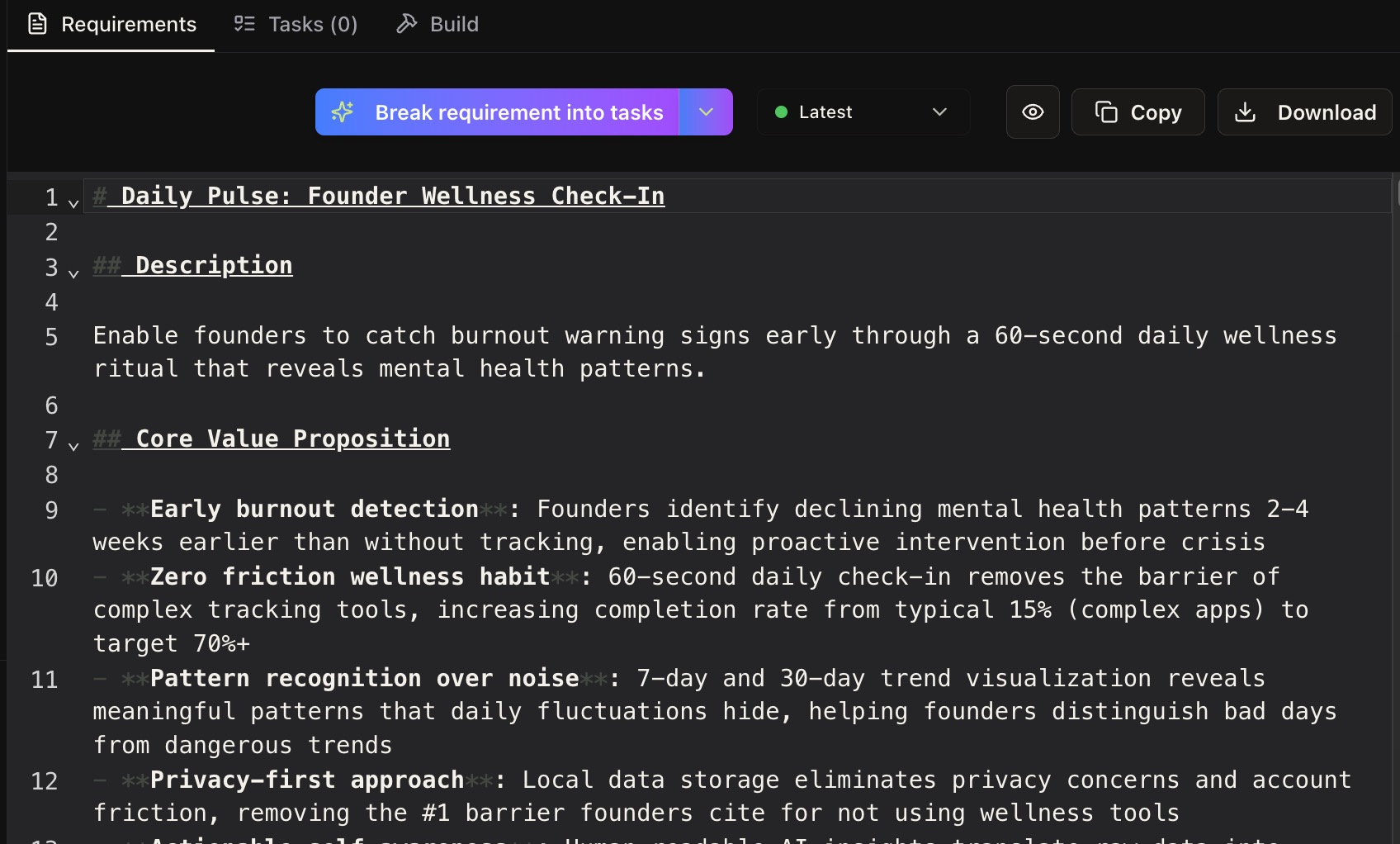
You can iterate with the BrainGrid AI to generate the perfect requirements document - getting insights and features you may not have initially thought about, but that will make your product more compelling. Then you can use BrainGrid to break the requirements into tasks — highly detailed prompts that give the AI agonizing detail that developers would take days to think out and write down. Using the BrainGrid MCP your vibe coding agent can read the prompts from the tasks, and build the feature you have in mind.
The detailed prompts from BrainGrid protect you as a developer: dodgy prompts lead to incorrect code, and many iterations of refactoring.
#Looking Ahead: What Year Two Looks Like
Vibe coding is celebrating its first anniversary in February 2026. After a momentous year, and being named the 'word of the year' in 2025 - what's next?
Next, agents will move from writing features to owning them. They'll persist across sessions and interact with each other. When frontend changes are made, the FE agents will interact with the BE agents to ensure that the code is correctly formatted to run the first time. The agents will be able to track other changes, technical debt, and proactively suggest fixes.
Specifications and features - like those created with BrainGrid - will replace the prompt. There will be default requirements that are held for each new code release to ensure that the new code remains stable, fast, and does not break existing features in the codebase.
#What This Means for You
Builders will stop typing code, and instead focus on shaping requirements, reviewing changes, and approving AI output. IDEs will move from the place where developers build, to a place where they monitor agents and the queues of the agents.
Founders with no coding experience will have greater success 'vibing' their MVP, and maybe even taking their service live - without hiring a developer!
The future of software development will be intertwined with vibe coding and AI agents. The momentum of the innovation seen in 2025 has not slowed and will only accelerate through 2026 and beyond. If you have not yet tried vibe coding, see our many reviews of vibe coding tools Windsurf vs. Cursor, Claude Code vs. Cursor, and more. Finally, vibe coding is not complete without AI Product Planning. We think BrainGrid is a great option to help build the best vibe coding prompts possible.
#FAQ
#What is vibe coding?
Vibe coding is an AI-assisted development practice where you describe what you want in natural language and let AI generate the code, accepting changes based on whether things work rather than reviewing every line. The term was coined by Andrej Karpathy in February 2025 and became Collins Dictionary's 2025 Word of the Year.
#Who invented vibe coding?
Andrej Karpathy, former AI lead at Tesla and co-founder of OpenAI, coined the term in a February 2025 tweet. However, the practice itself had been emerging for years through tools like GitHub Copilot (2021) and ChatGPT (2022). Karpathy gave a name to something millions were already doing.
#When did vibe coding start?
The term "vibe coding" was coined on February 2, 2025 in Karpathy's viral tweet. The underlying practice—using AI to generate code from natural language descriptions—had been growing since GitHub Copilot launched in June 2021 and accelerated dramatically after ChatGPT's release in November 2022.
#Is vibe coding safe for production?
Vibe coding can be safe for production when combined with structure and review. The problems emerge when developers accept AI output blindly without specs, tests, or verification. Tools like BrainGrid formalize "spec-driven development" to keep vibe coding's speed while adding necessary discipline.
#What's the difference between vibe coding and traditional coding?
Traditional coding involves writing and reviewing every line yourself. Vibe coding involves describing what you want and letting AI write the code, focusing your attention on whether outcomes work rather than implementation details. It's a shift from "writing code" to "directing AI."
#Will vibe coding replace programmers?
Vibe coding is changing what programmers do, not eliminating the need for them. By 2026, the emerging role is "Orchestrator"—someone who defines intent, sets constraints, and reviews AI output. Employment for junior developers has dropped 20% (Stanford study), but senior engineers who master AI direction are more valuable than ever.
About the Author
Doug has been helping developers build across mobile, DevOps, and AI for the last 20+ years. An O'Reilly author, international speaker, and a prolific blogger, he relishes in simplifying the complex.
Want to discuss AI coding workflows or share your experiences? Find me on X or connect on LinkedIn.
Keep Reading


Ready to build without the back-and-forth?
Turn messy thoughts into engineering-grade prompts that coding agents can nail the first time.
Re-love coding with AI