
Brand as Code
Why Your Brand Should Be Readable by Humans and Machines. AI can write your code, but it doesn't know your brand. Learn how to make your brand machine-readable for AI coding tools.
As software teams increasingly rely on LLMs and coding agents to build products, a quiet problem keeps showing up:
AI can write your code, but it does not know your brand.
It does not know your voice. It does not know your terminology. It does not know what words you never use. It does not know what "on-brand" looks like for your product.
At BrainGrid, this became painfully obvious during our recent rebrand.
#Our rebranding problem
When we rebranded BrainGrid, we ran into an unexpected issue.
Every time we asked an AI coding tool to update copy, docs, UI text, or marketing pages, we had to re-explain the brand from scratch.
Different tools produced different tones. Some sounded too corporate. Others sounded overly hype-driven. None were consistent without heavy prompting.
This was not a model problem.
It was a missing context problem.
So we asked a simple question:
What if brand lived like code?
#Introducing: Brand as Code
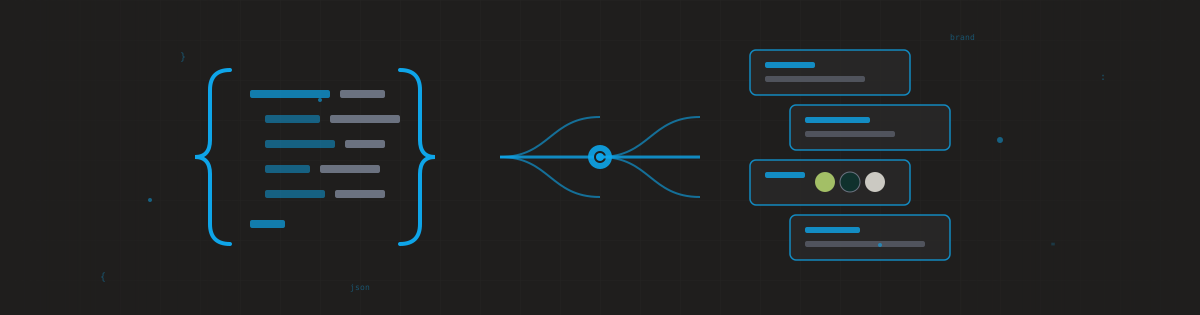
We created a single source of truth for the BrainGrid brand that both humans and machines can read.
You can see it live here:
- Human-readable brand overview: braingrid.ai/brand
- Machine-readable brand definition: braingrid.ai/brand.json and braingrid.ai/brand.txt
Machine-readable brand guidelines in JSON for AI agents and automated pipelines
Machine-readable brand guidelines in markdown for easy copy pasting and quick reference
These files describe how BrainGrid should sound, look, and behave across products, docs, and content.
Once this context existed, AI tools stopped guessing.
They started executing.
#What lives in Brand as Code
#1. Brand principles
Clear statements about what the brand stands for and what it avoids.
1{
2  "principles": [
3    "Clear over clever",
4    "Practical over hype",
5    "Respect the builder",
6    "Focus on reliability and craft"
7  ]
8}
This prevents AI from drifting into marketing fluff or generic startup language.
#2. Voice and tone
How the brand should sound in different situations.
1{
2  "voice": {
3    "tone": ["confident", "calm", "direct"],
4    "personality": ["builder-first", "practical", "honest"],
5    "style": [
6      "Plain language over jargon",
7      "Short sentences",
8      "Builder-first perspective",
9      "Respect the reader's time"
10    ],
11    "avoid": [
12      "Buzzwords",
13      "Excessive hype",
14      "Salesy language",
15      "Vague promises"
16    ]
17  }
18}
Now an LLM knows how to write BrainGrid copy without constant correction.
#3. Terminology rules
Words matter. Especially for AI.
1{
2  "terminology": {
3    "preferred": [
4      { "term": "AI Product Planner", "context": "Our core AI agent" },
5      { "term": "AI-native SaaS", "context": "Products built with AI from the start" },
6      { "term": "builders", "context": "Our users - founders, developers, product people" },
7      { "term": "requirements", "context": "What needs to be built" },
8      { "term": "ship", "context": "Get to production (not deploy or launch)" }
9    ],
10    "avoid": [
11      { "term": "magic", "reason": "Vague and hype-driven" },
12      { "term": "no-code", "reason": "We're for builders who ship real products" },
13      { "term": "one-click", "reason": "Oversimplifies real work" }
14    ]
15  }
16}
This alone eliminated a huge amount of inconsistency across our product and docs.
#4. Visual guidance for systems
Brand as Code does not replace designers, but it gives machines guardrails.
1{
2  "visualPersonality": {
3    "attributes": ["clean", "modern", "functional", "professional"],
4    "avoid": [
5      "Overly playful illustrations",
6      "Neon gradients",
7      "Gimmicky animations",
8      "Generic stock imagery"
9    ]
10  }
11}
This helps AI-generated UI and docs stay aligned with the product experience.
#5. Brand colors
AI tools need exact color values, not vague descriptions.
1{
2  "colors": {
3    "primary": [
4      {
5        "name": "Lime",
6        "hex": "#C2E476",
7        "cssVariable": "--color-brand-lime",
8        "tailwindClass": "bg-brand-lime"
9      },
10      {
11        "name": "Jungle",
12        "hex": "#10312D",
13        "cssVariable": "--color-brand-jungle",
14        "tailwindClass": "bg-brand-jungle"
15      },
16      {
17        "name": "Cream",
18        "hex": "#F3F1E8",
19        "cssVariable": "--color-brand-cream",
20        "tailwindClass": "bg-brand-cream"
21      }
22    ]
23  }
24}
This gives AI the exact color values to use when generating UI or styling suggestions. No more guessing hex codes.
#6. Logo assets
Machine-readable URLs for every logo variant.
1{
2  "logos": {
3    "primary": {
4      "name": "BrainGrid Logo",
5      "variants": [
6        {
7          "name": "Lime on Jungle (for dark backgrounds)",
8          "svg": "https://www.braingrid.ai/brand/full-logo-lime-on-jungle.svg"
9        },
10        {
11          "name": "Jungle on Lime (for light backgrounds)",
12          "svg": "https://www.braingrid.ai/brand/full-logo-jungle-on-lime.svg"
13        }
14      ]
15    },
16    "symbol": {
17      "name": "BrainGrid Symbol",
18      "variants": [
19        {
20          "name": "Lime on Jungle",
21          "svg": "https://www.braingrid.ai/brand/symbol-lime-on-jungle.svg"
22        }
23      ]
24    }
25  }
26}
AI tools can reference the correct logo variant based on context. Dark background? Use Lime on Jungle. Light background? Use Jungle on Lime.
#Using Brand as Code in practice
We tested this immediately.
We gave Claude Code our brand.json and asked it to update the BrainGrid documentation to match the new brand.
The result:
- Fewer revisions
- Less back and forth
- Far more consistency
- No tone drift across pages
You can see the outcome here: docs.braingrid.ai
The AI finally had the context it needed.
#Why this matters beyond BrainGrid
We believe we are on the verge of a massive shift.
Over the next few years, millions of SaaS products will be created by small teams and solo founders using AI.
In that world:
- Code is cheap
- Iteration is fast
- Differentiation matters more than ever
Your brand becomes a core system dependency.
If AI is building your product, your docs, your UI, and your marketing, then your brand must be legible to AI.
#Brand is no longer tribal knowledge
Historically, brand lived in slide decks, Figma files, and people's heads.
That does not scale when:
- Multiple AI agents are producing content
- Code is written by machines
- Products evolve daily, not quarterly
Brand needs to be:
- Explicit - No assumptions, everything documented
- Versioned - Track changes over time
- Portable - Works across any tool or system
- Machine-readable - AI can parse and apply it
In other words, brand needs to behave like code.
#A proposal to the community
What if every product shipped with:
/brand.json/brand.txt
Just like we expect:
package.jsonterraformopenapi.yaml
Not as a replacement for design or strategy, but as a contract between humans and machines.
We are starting with BrainGrid, but we believe this pattern will become standard.
#Building for the next million SaaS builders
At BrainGrid, our mission is to help builders turn ideas into reliable AI-native SaaS products.
That means more than code.
It means planning. It means structure. It means clarity. And yes, it means brand.
If AI is going to help build the future of software, we need to teach it what we care about.
Brand as Code is one small step in that direction.
About the Author
Nico Acosta is the Co-founder & CEO of BrainGrid, where we're building the future of AI-assisted software development. With over 20 years of experience in Product Management building developer platforms at companies like Twilio and AWS, Nico focuses on building platforms at scale that developers trust.
Want to discuss AI coding workflows or share your experiences? Find me on X or connect on LinkedIn.
Keep Reading


Ready to build without the back-and-forth?
Turn messy thoughts into engineering-grade prompts that coding agents can nail the first time.
Re-love coding with AI