
What Is a Product Management Agent?
AI coding tools changed who gets to build software. But without planning, things break. A Product Management Agent is the missing layer that turns messy ideas into reliable software.

AI coding tools have changed who gets to build software. A new generation of non-technical founders and domain experts can now turn ideas into working features with tools like Cursor, Claude Code, Replit, and Windsurf. You describe what you want, and the agent writes the code.
But anyone who has tried to build beyond a simple prototype knows the feeling: things start to break.
Features regress. Integrations behave inconsistently. The AI loses track of context. That one small tweak somehow breaks three other parts of the app. You are no longer building. You are firefighting.
The problem is not code generation. The problem is planning.
A Product Management Agent is the missing layer in this new AI stack. It acts like a product manager, systems thinker, and senior engineer working together. It turns messy ideas into clear specifications, breaks large projects into smaller tasks, asks the right clarifying questions, and gives coding agents the direction they need to deliver reliable software.
It is the bridge between human intent and machine execution.
#Why AI Coding Breaks Down Without a Product Management Layer
Most AI coding tools behave like very fast junior developers. They are powerful and eager, but they need clarity. Without structure and direction, they make assumptions, lose context, and rewrite things they should not touch.
The symptoms look like this:
- A small change breaks features that used to work
- The AI starts creating duplicate files or reorganizing code in confusing ways
- Complex requirements get misunderstood or oversimplified
- Integrations and edge cases fall apart as the app grows
Professional engineering teams solve this with product managers, system design, specs, PRDs, RFCs, and review processes. Vibe coders usually do not have those tools or that experience. They have an idea, an AI coding assistant, and a lot of trial and error.
A Product Management Agent brings that missing discipline into the AI workflow.
#What a Product Management Agent Actually Does
A Product Management Agent handles the thinking work that happens before and around code. It takes a builder's idea and transforms it into inputs that AI coding agents can execute correctly.
At BrainGrid AI, we train our Product Management Agent in a set of core skills that mirror what strong product managers and senior engineers do in healthy teams.
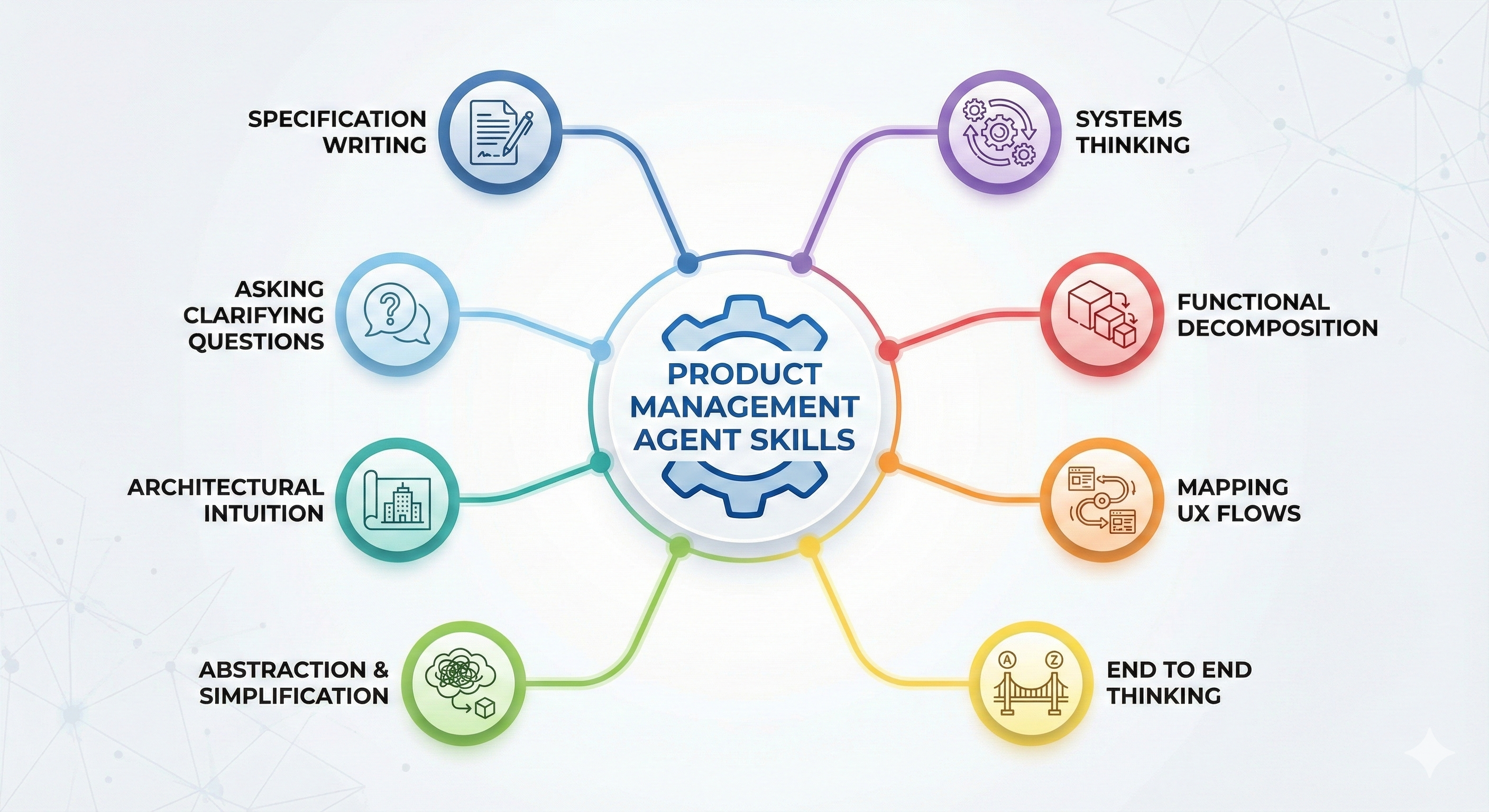
#1. Systems thinking
The agent learns to see the product as a system, not a collection of isolated features. It considers data flows, ownership, side effects, and how new work fits into the existing architecture. A change to notifications should not silently break permissions or billing.
#2. Functional decomposition
Large problems rarely get solved in a single request. The agent breaks big goals into logical, buildable pieces with clear goals and outcomes. This makes it easier for coding agents to stay on track and for builders to review the work step by step.
#3. Mapping UX flows
Features are not only technical. They are experienced by users. A Product Management Agent maps user journeys, entry points, success paths, and failure paths so the implementation supports a complete workflow, not just a single screen or endpoint. It thinks about what happens before and after each interaction.
#4. End-to-end thinking
A real feature touches more than one layer. It may affect APIs, UI, data models, permissions, validation, error handling, and analytics. The agent learns to think across the entire lifecycle of a feature so that nothing important is left out.
#5. Abstraction and simplification
Great engineers hide complexity behind clean interfaces. The agent develops an instinct for when to introduce a new abstraction, when to reuse an existing one, and how to keep the mental model simple for the builder. The goal is power without unnecessary complexity.
#6. Architectural intuition without over-architecting
There is a fine line between a solid foundation and over engineering. The agent learns patterns that help apps scale and stay maintainable, but avoids heavyweight solutions that slow down early teams. It aims for just enough architecture, with room to grow.
#7. Asking clarifying questions
Most failures in AI coding come from unspoken assumptions. The builder says "add 2FA" and the system needs to know: which users, which flows, what UX, what edge cases, what happens on failure. A Product Management Agent learns to ask targeted clarifying questions at the right time so hidden requirements surface before code is written.
#8. Specification writing
All of these skills come together in the ability to write clear, practical specs. A good specification includes goals, context, UX flows, constraints, edge cases, and acceptance criteria. Poor specs produce fragile software. Great specs produce reliable software that is easier to evolve.
These core skills enable effective task planning, sequencing, and review. Once the agent has a good specification, it can:
- Break it into well scoped tasks
- Create engineering grade prompts with the right context
- Define acceptance tests for each task
- Validate whether the output from the coding agent matches the intent
In other words, the Product Management Agent creates a stable path from idea to working code.
#Why This Matters for AI Builders
AI coding is powerful, but on its own it is still unpredictable. Builders often feel like they are rolling the dice every time they ask for a change in a complex app. A Product Management Agent gives them structure and repeatability.
This matters because:
- Features ship faster and with fewer surprises
- Less time is spent debugging regressions and strange side effects
- The codebase stays understandable and maintainable as it grows
- Non-technical founders can build like experienced teams
- AI coding tools become more of a reliable partner and less of a gamble
The Product Management Agent is not there to replace coding agents. It is there to guide them.
#Why We Built One at BrainGrid
At BrainGrid, we believe that AI coding tools are only half of the story. The other half is planning, structure, and product thinking. Without that half, non-technical founders get stuck in loops of rebuilds, half broken features, and abandoned projects.
So we built the Product Management Agent as the first layer of the BrainGrid platform.
BrainGrid turns ideas into specs, plans features, maps UX flows, asks clarifying questions, breaks work into tasks, and generates engineering grade prompts and acceptance criteria. Coding agents then use this structure to build features that are more likely to work the first time and keep working as the product evolves.
Our goal is simple: Make AI coding reliable enough that anyone with a good idea can build a real product.
About the Author
Nico Acosta is the Co-founder & CEO of BrainGrid, where we're building the future of AI-assisted software development. With over 20 years of experience in Product Management building developer platforms at companies like Twilio and AWS, Nico focuses on building platforms at scale that developers trust.
Want to discuss AI coding workflows or share your experiences? Find me on X or connect on LinkedIn.
Keep Reading


Ready to build without the back-and-forth?
Turn messy thoughts into engineering-grade prompts that coding agents can nail the first time.
Re-love coding with AI