
Builder Story: No Engineering Background, No Problem — Audrius and Deep Focus
He couldn't write code, but he knew what good products looked like. How BrainGrid turned a marketer's product instincts into a live focus app with Google Calendar sync, shared sessions, and analytics.
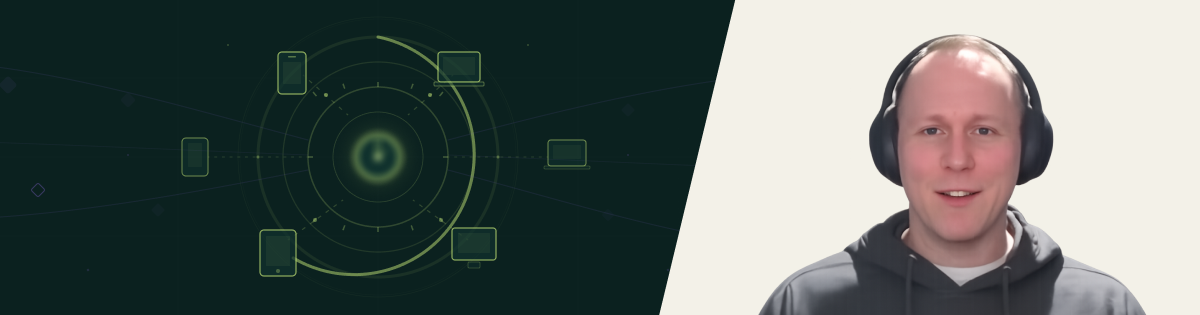
"I could not do that without good requirements and BrainGrid in this case." — Audrius
#Background: The Marketer Who Decided to Build
#Who is the builder?
Audrius comes from a marketing background with years of corporate experience. He is not an engineer. He learned the basics of Python, HTML, and CSS, enough to read code but not write it from scratch. When the vibe coding movement took off in 2025, he saw an opportunity to finally build the tools he had been thinking about for years.
But he quickly learned something that his corporate career had already taught him. The IT engineers he used to work with were always asking for the same thing: good requirements. AI coding tools were no different.
"What you give is what you get."
That realization led him to BrainGrid.
#His Development Setup
Audrius has iterated through several tools on his journey. He started with Lovable, moved to Cursor, and eventually landed on his current setup:
- Coding agent: Claude Code
- Planning and specs: BrainGrid (via MCP)
- Research and clarification: Gemini
His workflow starts with dictating ideas into Gemini, then pushing those into BrainGrid for structured requirements. From there, he implements through Claude Code.
#Vision: Helping People Stay Focused
#What is he building?
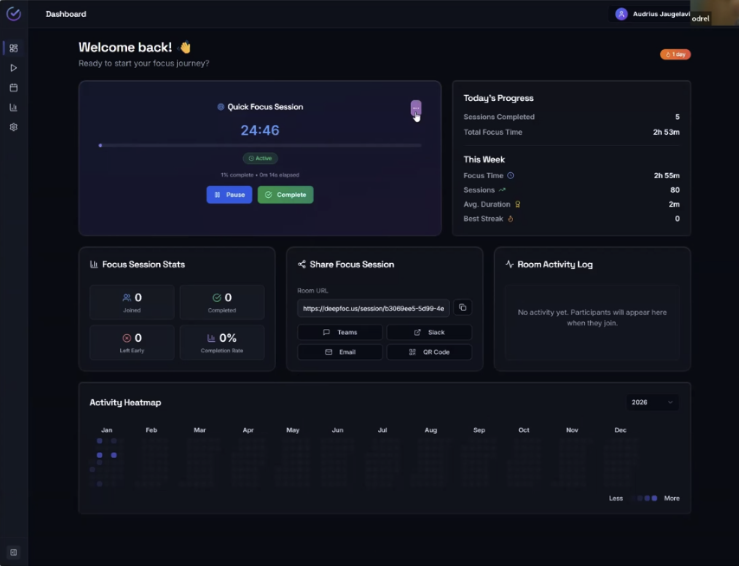
Audrius is building Deep Focus, a focus timer application with calendar syncing, shared sessions, and analytics. On the surface it sounds simple. In practice, it turned out to be anything but.
#Who is it for?
Deep Focus targets productivity-minded users, with a particular focus on people with ADHD who struggle to concentrate and stick to tasks. Audrius has segmented his ideal customer profiles and is preparing targeted marketing campaigns across SEO, answer engine optimization, TikTok, and other social channels.
#What does it solve?
There are plenty of timer apps out there. Deep Focus differentiates itself through Google Calendar integration. When you finish a focus session, it syncs to a secondary calendar in your Google account, giving you a visual record of your deep work without touching your main calendar. You can also share live sessions with others and track your focus patterns through an analytics dashboard.
#Long-term vision
Audrius plans to accelerate marketing, build traction, and see where the product goes. He is keeping his options open, whether that means scaling it, maintaining it as a side project, or eventually selling it.
#The Turning Point: Choosing BrainGrid
#The challenge: A "simple" timer that wasn't simple at all
Audrius thought he was building a simple timer. Then reality hit.
If you reload the page, the timer resets. Open a new browser tab, it resets. Close the app and reopen it, it resets. Switch from desktop to phone, it resets. What seemed like a straightforward feature turned into a persistent state management problem that had Audrius spinning.
That was the moment BrainGrid made a real difference. One of his first requirements was ensuring sessions continue across page reloads, new tabs, browser closures, and even different devices. BrainGrid helped him define that requirement clearly, think through the edge cases, and produce a plan that his coding agent could execute.
Today, the timer state syncs across all devices and all browsers.
#The follow-up questions changed everything
For Audrius, the most valuable part of BrainGrid is the follow-up questions. When he submits an idea, BrainGrid comes back with clarifying questions that surface things he had not considered.
"Those follow-up questions, it's a goldmine. I did not think about that and that. That's where your product helped me a lot."
Other tools have started adding planning modes, but Audrius finds that BrainGrid's questions are more detailed, more comprehensive, and better at bridging both technical and product concerns. They force him to think through what he actually wants before any code gets written.
#Outcomes: From Zero Engineering to a Live Product
#A live app in three months
Audrius built Deep Focus in roughly three months, going from no engineering background to a live, functional application. The app includes Google sign-in authentication, persistent cross-device timer sessions, Google Calendar syncing with a dedicated secondary calendar, shared focus sessions with live participant tracking, session templates for quick starts, an analytics dashboard with focus hours distribution and activity heat maps, and customizable session themes.
That is a significant feature set for someone who describes himself as unable to write code.
#Learning to think like an engineer
Beyond the product itself, Audrius is gaining something harder to measure. He reads every plan BrainGrid generates and is starting to understand how software systems are structured, how one module affects another, and how to communicate technical ideas effectively.
"It's giving me that understanding of how the structure works, how one module affects the other one. I'm already getting the feeling for what is needed."
He went from saying "I want this and this" with many unanswered questions to understanding that the quality of what you describe directly determines the quality of what gets built.
#Google Calendar integration
One of the more technically ambitious features, Google Calendar syncing, is working in production. Focus sessions sync to a secondary calendar so users can see their deep work alongside their regular schedule. The implementation required OAuth flows, calendar API integration, and careful handling of event creation. For a non-engineer, this is a real accomplishment.
#What He Wants Next from BrainGrid
Audrius had one clear request: better image support in the chat interface. He had previously struggled with pasting screenshots into BrainGrid and had to work around it by describing images through Gemini first. (This has since been fixed, and image uploads are now fully supported.)
Beyond that, he was satisfied with the current feature set. The follow-up questions, code-aware planning, and requirement generation are doing exactly what he needs.
#Final Thoughts
Audrius's story is proof that you do not need an engineering background to build real software. What you need is clarity about what you want to build and a system that forces you to think it through before you start.
BrainGrid gave him that system. The follow-up questions caught what he missed. The plans taught him how software works. And the structured requirements gave his coding agents something they could actually execute on.
Deep Focus is live, nearly launch-ready, and built entirely by someone who cannot write code. That is the power of good requirements.
Keep Reading


Ready to build without the back-and-forth?
Turn messy thoughts into engineering-grade prompts that coding agents can nail the first time.
Re-love coding with AI